This seemingly nondescript space located on the north-side of Ashford Avenue is home to a piece of art from a rather influential artist. Fernando Botero Park, a tiny concrete alcove in the Condado district of the Santurce sector, received its’ current name in 2000, when Fernando Botero’s Madre y Hijo was installed. Previously, the space was called La Plaza de Ancla (Anchor Plaza), and was home to a piece called Cardumen Onirico by Carlos Guzman.
View from the Southwest. The small public park takes up little more than 1/3rd of an acre. The Serafina Beach Hotel lies in the background.
As part of San Juans’ continuous efforts to revitalize Condado, the hotel and nightlife district to the East of Old San Juan, the aging and under-maintained Cardumen Onirico was removed and Madre y Hijo created in 1991 by Columbian artist Botero, was installed.
The water feature has seen better days.From the rear of the park, facing Southeast. Even on a beautiful day, these benches will remain unused.The main feature. No plaque needed
With Madre y Hijo, Fernando Botero illustrated a scene we’ve all seen before, although in many different ways. A mother sitting stoically, while holding her newborn close. The arrival of this statue was heralded by many as a major step towards Condado becoming a destination, not just for beaches and nightlife, but for arts and culture.
The small park, in my opinion, is a bit outclassed by its’ surroundings. To be fair, there’s really no extra space available between the street and the beach.
You may recognize this type of artwork, in fact it has its’ own name: Boterismo. It’s Botero’s own unique style of exaggerating and over-emphasizing forms on humans as well as animals. His work, mostly still paintings and bronze statues like the one in Condado, can be found all over the world, from Berlin, to Singapore, to New York City. In fact, by many accounts, he is Latin Americas’ most quoted and recognizable living artist.
I believe this piece of artwork deserves to be in a better location, one that would provide it with a broader audience. I truly believe that this is an awkward space, that doesn’t seem to fulfill any purpose other than as an outdoor art gallery.
The path on the parks western edge signals to the visitor that this is route they should take in order to get to the back of the park, where they’ll be closest to the ocean. Why, then, is it so narrow? Even though it’s obviously physically wide enough to fit two people side by side, making it a bit wider and inviting might encourage more people to walk through. Also, when the park was new, each of those poles held up a sculpture, meant to represent a dolphin. Now only one remains, while the others serve as vantage points for birds.The final feature is this pavilion. I don’t know what its’ intended purpose is, and i’ve never seen it utilized.This is Cardumen Onirico (Sleeping Fish) by Carlos Guzman. With the background dolphins intact, I truly believe the space was better with this piece. I believe the light posts you see, as well as the dolphins, all came down during one of the hurricanes that hit the island in recent years. You can also see that a few trees were planted in the space right next to the sculpture. Look closely to find the man who thought the space was comfortable enough to take an afternoon nap in. Photohttp://petrusgallery.com/wp-content/uploads/2016/08/Cardúmen-on%C3%ADrico.jpg
The previous design seems much more cohesive to me. Considering that the reason the park is located where it is is because it serves as a window to the ocean, having a structure with a lower, less commanding profile would make more sense.
From my experience, many of the people who stroll down Ashford Avenue are tourists and, even if they’re not, they’re usually there to visit a beach, or to walk to nearby shopping, restaurants, and night life. In my opinion, Botero’s piece should be moved to an area in or around Old San Juan, where people generally go to appreciate the arts and culture of San Juan.
But even i’m completely wrong, the lack of visitors to this small park seems to speak for itself. It’s almost always deserted, save for an occasional tourist meandering through to view the ocean or, more commonly, take a selfie. On the day I set out specifically to photograph and observe the park – a long time after i’d already written it off as a deadline – I arrived at about 4:00 pm on a Friday afternoon. In the time it took my snap my photos – about 15 to 20 minutes – there were about 20 to 25 passersby, but no park visitors. I probably should have hung around a bit longer, just to see what types of people would stop, if any at all, but I was quite certain it wasn’t worth my time. After all, any commons, park, or public space needs to be at least sparsely inhabited to be successful. If a park goes un-enjoyed, even if it’s just for a short amount of time, it’s not performing to it’s full potential.
I passed by the park on my way home, as was pleasantly surprised to find a group of 5 young ladies taking selfies by the ocean. How can Fernando Botero Park improve itself to take advantage of its’ ocean vista in order to attract more of these people and, even better, make them stay?
I tend to refer to almost every public space intended for human recreation or enjoyment as a park, even if it doesn’t have any green space at all. Conversely, I almost never refer to a space as a commons, even though it is the most common and widely used type of space out of the three.
What do these three terms mean, why is it important to distinguish between them, and how do those differences aid us in observing an urban ecosystem?
Krymskaya Embankment on the Moskva River, Moscow. Serves as a commons along the river-side walkway as well as a public space where people can meet and appreciate the surrounding artwork. Photo: Wowhaus Archive
We’ll start with the easiest to define: The Commons. It is simply a space where people go. A church, a shopping center, a library, a food truck, a street, a skate park, a train station; any area that is frequently used by people could be a commons.
If you had 1,000 flyers that you needed to give to people who live in your town, you would go to your commons, wherever that may be. There’s a reason you’ll often find people collecting for charity, or girl scouts selling cookies, outside of busy supermarkets.
For many Americans, supermarkets and large box stores make up a large portion of the collective commons. Besides work and school, this may be the only place you run into people from your town. Photo: https://www.flickr.com/photos/walmart3/12331640945
For suburban or rural dwellers, that commons may be inside a shopping mall, at a busy college campus, or in front of a supermarket. For urban dwellers, where a smaller amount of space is utilized by a larger number of people, a busy street corner might suffice. Think of where you see canvassers, beggars, street performers, and people selling their wares to passersby; they all generally choose a location near which many people will pass by throughout the day.
Besides the presence of people, there isn’t much more we need to do to define a commons. It can take up pretty much any form possible – it can even take the form of a park or a public space. It doesn’t need to have a specific form to be successful. All that matters is that humans have a reason to occupy it. A commons is working when it’s bringing in a large number of people, relative to the spaces around it.
Lets take this shopping promenade in Santa Monica, California for example.
It resembles any other successful promenade area. Some people appear to be walking, while others are standing in groups. It seems there’s as much reason to stand around as there is to keep moving. The space certainly seems large enough to handle the amount of foot traffic, but with enough trees, kiosks, and hanging fliers to prevent the space from seeming too open.
Now, look again at the people in the photo… how many shopping bags can you spot? I can only spot two bags, both from the same high-end clothing store. This is a shopping center, right? Well, yes, but it’s also a commons. I’d guess that the majority of people in this photo, even if they walk into multiple stores, will return home without any bags at all.
The reason why this commons is successful is because it fulfills other wants and needs besides shopping. Some of these people are on their way to a restaurant, some of them are there to meet up with friends, some are going for an afternoon walk, some are people-watching, and some are just killing some time before they go to work – possibly at a business somewhere in the same promenade.
We gravitate to places like these promenades because we enjoy the presence of other people; the visibility of being in public, complemented by the anonymity of being in the crowd.
A public space doesn’t necessarily have to be considered an entirely different concept from a commons. The primary difference is that a public space should, in most cases, be an attraction within itself; a defined area that provides a sense of inclusion, and that incorporates certain elements of architecture, visual art, and landscaping to create a sense of ambience. Whereas the primary purpose of the promenade is to provide a pleasant atmosphere for shoppers, the primary purpose of, say, Logan Square park in Philadelphia, is to attract people to stop and take in the sites.
Could Logan Square be considered a commons? Sure. But it’s more accurately defined as a public space because of the intent behind its’ design. The fountain, the benches, the greenery, the view of City Hall; all of this was kept in mind when William Penn designated this space as a park in 1684, and in 1924, when the square gained its’ iconic fountain. Even though the square, in its’ current guise, is completely cut off by a multilane traffic circle, and is often inhabited by the citys’ homeless, its’ still a popular stopping point for locals and tourists alike.
Another important function of public space is to serve as a public forum. When you have a message that needs to be spread, you need to to be somewhere that’s accessible to as many people as possible, and that’s large and open enough to contain the crowds that come to see you. William Penn, a forward-thinking man and an early advocate of Democracy, understood how important it was to provide forums for both personal and political expression, which is why his design for Philadelphia was built around its’ five public squares.
Now, I can think of about a dozen spaces in Philadelphia that would be better places to hold a public forum than Logan Square, but, indeed, the space has been home to a Women’s March, a Papal visit, and a portion of the NFL Draft all in the last couple of years.
If a space can attract a variety of people, not just for it’s aesthetics, but for its’ use as a public forum, it will usually be a successful public space.
Finally, we can address parks. When you say you’re going to the park, you may be referring to a variety of different types of spaces. Maybe going to the park means taking a hike up a mountain trail on the edge of town. Maybe it’s jogging through an expertly landscaped suburban park. If you live in an urban setting, it could be as simple as walking a few blocks to a neighborhood playground or greenspace. In this case, i’ll focus on urban parks, as the physical limitations of a city make them unique to larger suburban and wilderness parks.
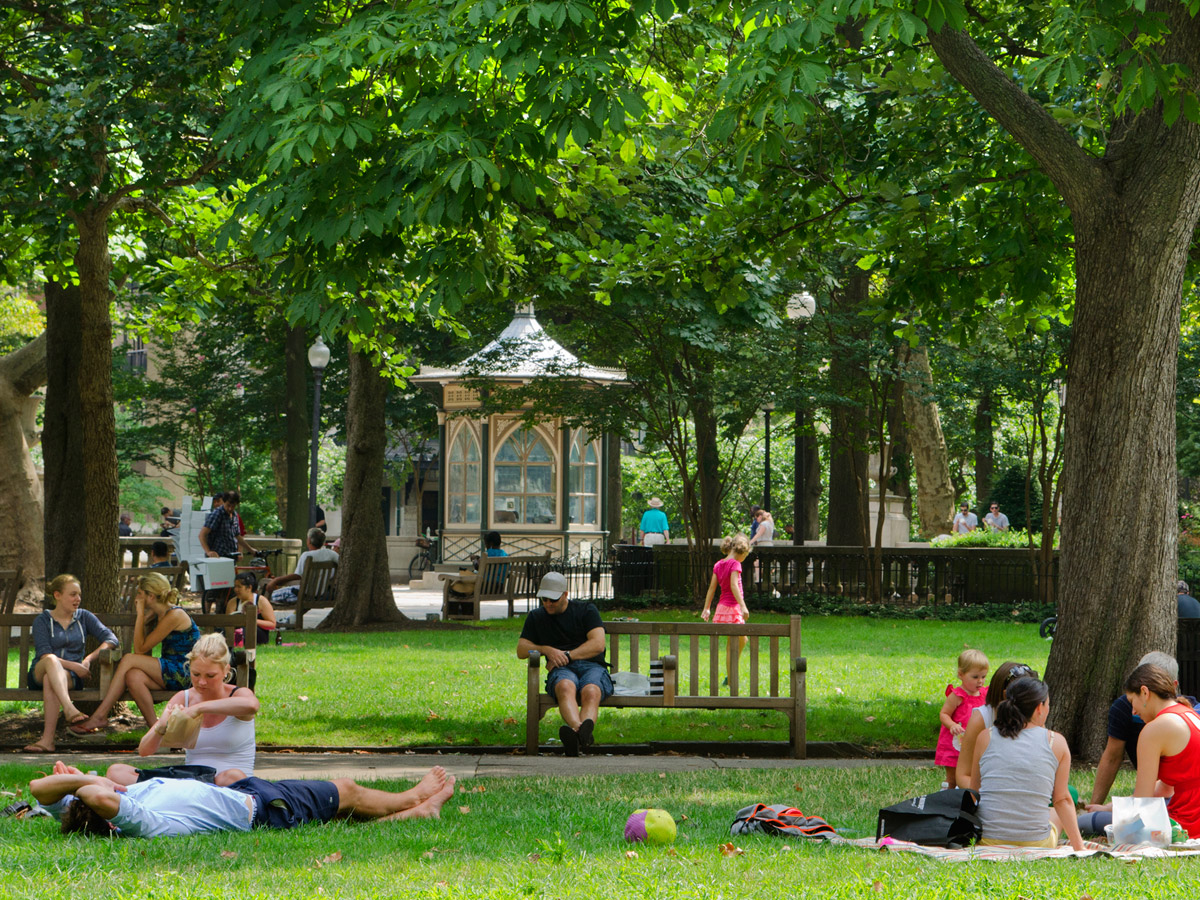
A city park, while building on the sociability of the commons and the inclusiveness of the public space, needs to add a third benefit. While encouraging social behavior and a sense of place, it also needs to serve as an oasis from the loud sights and sounds of the urban environment. The unforgiving steel and concrete of the buildings and light posts are replaced with the lushness of trees and grass. Busy sidewalks and storefronts, which encourage people to keep moving, are replaced with meandering paths and benches, which encourage people to stop and relax.
Rittenhouse Square, another one of William Penn’s public squares, is the finest park in Philadelphia, and serves as an example for how to build a moderately sized city park. It’s in habited at nearly all hours of the day by nearly every type of person in Philadelphia. This park doesn’t necessarily offer any services that can’t be found in other similar parks, nor is it’s size or architecture all that noteworthy. It’s loved by Philadelphians because it provides an oasis from the bustling nature of Center City, and it does that while being accessible and inclusive to everyone in the city. Whether it’s to take the dog for a walk, get some sun while laying in the grass, sit and read on a bench, meet someone new, or to conduct a late-night drug deal, Rittenhouse seems to fulfill all of those wants and needs, without necessarily going above and beyond what a park is meant to do.
In this regard, a city park can be described as a public space that incorporates green-space to provide the visitor with a sense of reprieve from some of the inhospitable aspects of the city. It’s also true that a park, much like Rittenhouse Square, can simultaneously be a commons, a public space, and a park, while excelling in all three categories.


 Space+Place